|
On April 2, CALCE hosted a meeting that brought together leaders from academia, government, and industry to discuss electronic parts engineering and the future of the electronics supply chain, in the context of providing graduate and certification programs for NASA. Representatives from NASA's Jet Propulsion Laboratory (JPL) and the Goddard Space Flight Center (GSFC) participated in the program with presentations, content reviews, and suggested updates to the proposed programs. Other participants included speakers from Auburn University and the University of Central Florida, as well as representatives from Lockheed Martin, John Deere, and other industry sectors.
Component Engineering has become much more important as electronic systems have grown more complex and mission lifecycles have extended significantly. What once seemed like a simple matter of sourcing parts now demands deeper expertise in reliability, sustainment, obsolescence, and risk management throughout the entire supply chain. As Prof. Sandborn and Dr. Das emphasized, the challenge is no longer just obtaining a component when needed, but ensuring it stays trustworthy, available, and functional over time. In this way, component engineering is not just a technical specialty; it is vital for mission success and sustained system support.
The participants included Susana Douglas and Matthew Minogue of NASA Goddard Space Flight Center; Seth Gordon and Shri Agarwal of NASA Jet Propulsion Laboratory; John Bescup of JPL/University of Central Florida; Katrina Groth, Prof. Patrick McCluskey, Prof. Peter Sandborn, and Dr. Diganta Das from the University of Maryland; Carman Grasso of Lockheed Martin; DeWayne Hatcher of John Deere; and Andre Kleyner of Kleyner Reliability Consulting LLC. In addition, several graduate students from the University of Maryland participated.
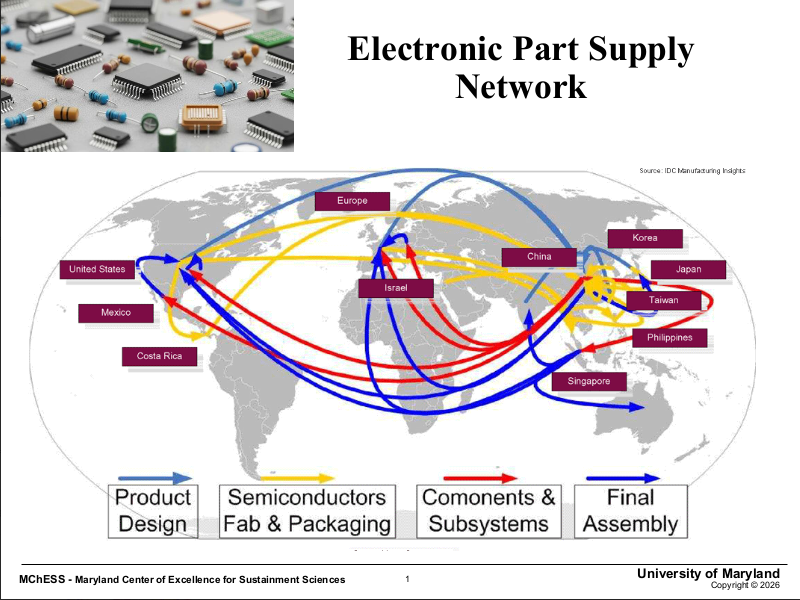
The presentations from CALCE highlighted how broad the electronics supply chain really is, spanning original manufacturers and distributors, test laboratories, system integrators, operators, and maintenance links, with responsibility shared across the entire network. It also reflected CALCE’s hands-on focus by highlighting topics such as obsolescence forecasting, manufacturer and distributor assessments, process change notices, qualification reports, and standards-based counterfeit detection. Together, the discussion reflected CALCE’s broader work at Maryland in reliability, supply-chain management, and advanced life-cycle engineering for electronic systems.
For more information about the Parts Engineering Course from NASA, contact Prof. Patrick McCluskey and Prof. Peter Sandborn.
For information on CALCE’s Professional Development Courses, please reach out to Dr. Diganta Das.
April 6, 2026
|