|
 |
From left: Jon Coile, Peter Nyce, and Richard Halstrick received the Wright Brothers’ Master Pilot award at a ceremony held at College Park Airport on March 7.
|
|
It’s been a half-century since three friends with a passion for flying attended the University of Maryland (UMD), where they joined the university’s flying club and competed in National Intercollegiate Flying Association competitions, reaching the finals in 1977.
Jon Coile '79, Richard Halstrick '80, and Peter Nyce '85 have continued to fly since then, with Halstrick and Nyce becoming professional aviators and Coile, a real estate executive, flying for business and fun. On March 7, recognizing their more than fifty years of safe flying, the Federal Aviation Administration (FAA) presented all three with its Wright Brothers Master Pilot Award during a special ceremony at College Park Airport.
The most prestigious honor given by the FAA to certified pilots, the award recognizes “individuals who have exhibited exemplary aviation expertise, distinguished professionalism, and steadfast commitment, according to FAA documents.
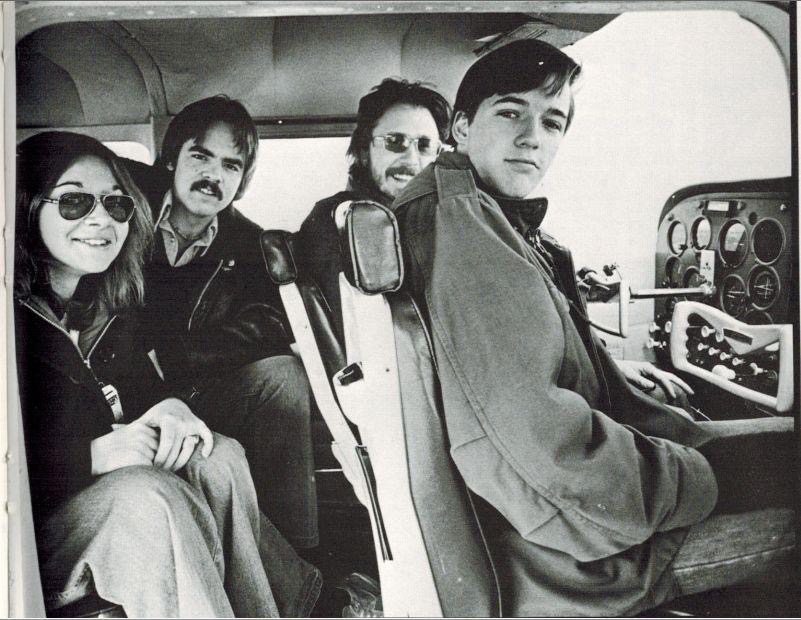
UMD Flying Club members Janice Colvin, Jon Coile, Richard Halstrick, and Pete Nyce are shown in this picture from the University of Maryland’s 1978 Yearbook.
Coile, Halstrick, and Nyce demonstrated that commitment early on, when they not only competed for UMD in their student days, but also served as officers of the flying club, growing its membership to more than 300. Among other exciting activities, the club flew people on short demo flights out of College Park Airport, and organized island-hopping excursions to the Bahamas during winter and spring breaks. It even operated a ground school for aspiring pilots.
“We were the largest special interest group on campus,” Coile recalls.
Halstrick and Nyce went on to make aviation their careers. Halstrick flew jump planes for skydivers, became a commuter and corporate jet pilot, and later captained heavy jets flying international routes for UPS.
Nyce flew F-4 Phantom and F-16 fighters in the military and then became a captain for American Airlines. While Coile’s career took him into business and real estate rather than aviation, he has continued to be an enthusiastic pilot, making many coast-to-coast trips and racking up more than 2,548 flight hours.
How have the three maintained stellar safety records during the fifty years since their first solo flights? Mainly by knowing and applying the rules, not flying into dangerous conditions, and resisting the urge to compromise safety in order to reach a destination on schedule.
“I really don't think there's any big secret to safe flying,” Halstrick said. “The FAA’s rules exist for a reason, and they’re part of why flying is so safe. It’s also important to be respectful of the weather. There are some kinds of weather that planes just can’t fly through, and the smaller the airplane, the less weather it’s capable of handling.”
So-called “get-there-itis,” in which pilots focus on swift arrival rather than safety, can cause some to get in over their heads, for instance by entering instrument conditions without adequate instrument training. Notable examples include the helicopter crash that killed Kobe Bryant and John F. Kennedy, Jr. 's crash en route to Martha’s Vineyard in 1999.
Staying focused is critical for pilots at any level of experience, according to Nyce. “People just starting out normally aren’t complacent, but complacency can settle in when you reach a certain experience level,” he said. “In tactical aviation, incidents of controlled flight into terrain often involve more experienced aviators.”
After he made the move to commercial flying, Nyce says, he always kept in mind that the well-being of passengers was at stake. “Knowing that I had that responsibility on my shoulders kept me vigilant,” he said.
Veteran Pilots’ Most Challenging Moments
While the three UMD alums have always put safety first, that doesn’t mean they haven’t experienced moments that challenged their skills. On one occasion, Coile recalls, conditions changed swiftly and he found himself flying into a storm, causing the plane to bank right and left as hail pelted the fuselage.
“I did what you’re supposed to do in such a situation: slow the plane down and keep the attitude level,” he said. “What you want to avoid is subjecting the plane to forces that can rip off the wings.”
A heart-pumping moment for Halstrick came when wind shear caused a DC-8 he was co-piloting to drop precipitously, resulting in a hard landing. He also recalls landing at a local airport in total darkness after a skydiving trip went on too long; difficulties lining up with the runway forced him to make a go-around. On the second try, he found someone had driven a truck up to the location, shining their lights on the runway to help him land.
Nyce once lost both engines and throttle control while flying an F-16 over Patuxent RIver in Southern Maryland, leading him to execute a flameout landing—that is, one without power. Later, he was told the maneuver succeeds only about 50% of the time.
Those “war stories” aside, all three pilots say the experience of flying is a thrill, and their enthusiasm remains undiminished after a half-century. Halstrick, for instance, is building his own Kolb Twinstar MkIII light sport plane and plans to obtain instructor certification, partly in order to teach his own children how to fly.
Coile credits the long history of aviation-related programs available through the University of Maryland System—including the aerospace engineering program at University of Maryland College Park and the comprehensive flight training program offered by the University of Maryland Eastern Shore—with inspiring generations of pilots.
“There’s just a lot of opportunity for young people with an interest in flying,” he said. “It’s exciting to see.”
March 12, 2026
|